


Russia has closed Nord Stream. According to internal documents, it wants to avoid a giant crisis that is expected to…

The dance around the closure of Nord Stream seems to be over. Russia just closed it. He says he will do so until Europe lifts the sanctions against him. The question is whether this will actually be the case and whether the situation will change again in a few days' time. In any case, this move is the result of the fact that, according to an internal report, the Russian economy is and will be much worse off than is being presented publicly.

Nord Stream, the main backbone line for transporting Russian gas to Europe, is filling the headlines again and again. This time, Gazprom is explaining the non-operation of Nord Stream by an alleged technical fault. It also refers to Siemens, on which it says the resumption of gas supplies depends. The Kremlin, for its part, says that supplies will not resume until the European Union lifts sanctions against Russia.

Development of the amount of gas delivered via Nord Stream, source: statista.com
These sanctions are a major thorn in the Kremlin's side. Although for a long time it seemed that the sanctions imposed did not bother Russia much and Europe was rather hurting itself, the reality is different. This is reflected in a leaked internal report that predicts three possible scenarios.
What does the report say?
The document contains three scenarios, which are the result of months of work by officials and experts. Two of the three scenarios predict that the economic downturn will gather pace next year. The economy is not expected to return to pre-war levels until the end of the decade or even later. "The 'Stressed' scenario sees the economy 8.3% lower than in 2021. The 'Stressed' scenario is even more depressing, predicting the economy to fall by as much as 11.9% below last year. For the record, we are talking about GDP growth.
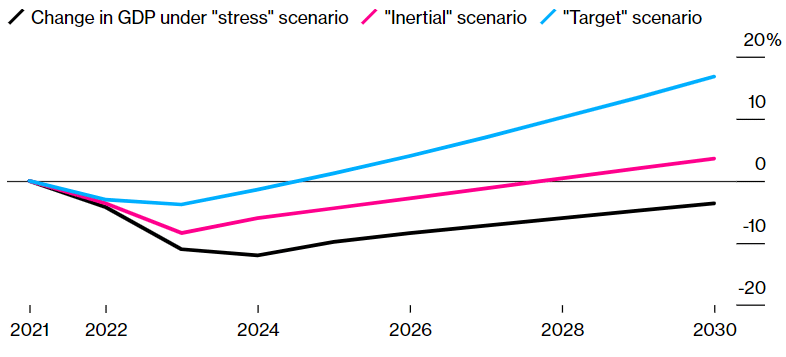
In the darkest scenario, GDP is projected to continue to decline over the next decade, source: bloomberg.com
These forecasts are supported by various arguments. Russia is aware of how dependent Europe is on its gas. But of course, it works the other way round too, and Russia will miss the money for its gas. The Kremlin argues that Europe's diversion from Russian gas could also create problems in supplying its own market.
It is estimated that Russia could face a huge brain drain. By 2025, this could number up to 200,000 IT professionals.
If gas is cut off from Europe, its main export commodity, in the long term, it could cost Russia as much as 400 billion rubles ($6.6 billion) a year. Russia would understandably try to find other buyers, but the lost revenue would be far from recoverable in the medium term.
Of course, sanctions do not only affect exports, but also imports. And for some imports, there is simply no alternative. The report gives illustrative examples of different import-dependent sectors:
Engineering: 70% of machine tools are foreign-made
Road transport: EU sanctions have tripled road transport costs
Pharmaceuticals: 80% of domestic production is dependent on imports
Aviation: 95% of air transport is carried out using foreign-made aircraft, no access to spare parts
Agriculture: 99% of poultry production and 30% of cattle production depends on imports; seed for sugar beet, potatoes, fish feed, amino acids are imported
How do you think things will turn out with Russian gas? Will the gas supply be cut off for good? Or is this a plan by Moscow to force an end to sanctions?
Ten artykuł został napisany i sprawdzony zgodnie ze standardami redakcyjnymi Bulios.
Obserwuj Bulios w Wiadomościach Google
Bądź wśród pierwszych, którzy poznają nowe analizy, wiadomości i ruchy na rynkach.
Polecane artykuły
 BLACK
BLACKRheinmetall po spadku o 45 %: Berlin zatopił fregaty, a rynek grzebie zbrojeniowego championa. Słusznie?
 BLACK
BLACK BLACK
BLACK